
Sequoia National Park 1-Day Itinerary: How To Visit In Winter
Looking to see the biggest trees in the world? Spend some time in Sequoia National Park with this 1-day winter itinerary, and you might even see some snow.
I used to think that there wasn’t much to do in Sequoia in winter, plus I’d seen the General Sherman tree before. However, this time we stayed overnight outside the park so that we could have a full day to hike to lesser known groves and trails.
Planning a winter trip to Sequoia can be slightly confusing because of potential trail or road closures. We planned this itinerary in a way that we could enjoy it no matter how much snow had fallen. In fact, it’s even better with more snow!
Read on for our detailed itinerary on how to spend a day in Sequoia during winter, including where to stay and things to bring.
This article uses affiliate links where I make a small commission if you make a purchase through my links, at no additional cost to you. As an Amazon Associate I earn from qualifying purchases.
Where to stay near Sequoia National Park
The best way to enjoy Sequoia National Park is to stay at least 1 night outside the park, especially during winter. While we prefer staying in Three Rivers, Visalia and Fresno are great options too – depending on your overall route and budget.
Three Rivers

Best for convenient access via Ash Mountain entrance
Three Rivers is just a 1-hour drive from the Sequoia National Park, with the Ash Mountain entrance just a couple of minutes’ drive away. There’s plenty of accommodation and dining options in the town, and the landscape is unexpectedly beautiful.
We stayed at Lazy J Ranch Motel because prices were relatively affordable, with spacious rooms and access to the river. They even have some goat and sheep on the property, and during the holidays they have festive inflatables and decoration to liven up the mood.
You’ll also have easy access to gas, grocery supplies, and coffee when staying in this gateway town to Sequoia National Park. In addition, we were approaching Sequoia from the south so Three Rivers was the perfect stay for us.
Check winter prices for Lazy J Ranch Motel
Fresno
Best stop on the way to Yosemite National Park
If you’re traveling to/from Yosemite National Park, Fresno is a convenient mid-way stop to rest between destinations. I planned it like this during our 10-day California road trip, so that you won’t have to drive for too long on any day.
We booked an Airbnb near the Fresno Blossom Trail and felt quite comfortable there. If you’re looking for a fuss-free overnight stop, Fresno is a convenient place to stay.
Book vacation rentals in Fresno
Sequoia 1-day itinerary during winter
Let’s start planning your ideal one-day itinerary for visiting Sequoia National Park in winter. It’s perfectly paced for you to enjoy a cup of coffee, sit under the trees with your lunch, and enjoy the scenic drive through the mountains.

Breakfast in Three Rivers
But first, coffee. There’s nothing more satisfying than a cup of warm coffee on a cold winter morning, so make sure to include this in your itinerary if you’re staying in Three Rivers.
We got coffee and breakfast at Sequoia Coffee & Co which already had a line when we arrived at 7:30am. It moved quite quickly though, and most people seemed to take their breakfast and coffee to-go as the outdoor seats were wet from the rain.
If you prefer to dine in for breakfast, Kaweah Coffee Roasters is also a cozy place with good coffee. I really enjoyed their ham and cheese muffin sandwich, and the breakfast taco was a close contender.
Drive into Sequoia National Park via Ash Mountain entrance

After a quick breakfast, we drove straight to the Ash Mountain entrance of Sequoia National Park. You’re greeted by the welcome sign, where you can pull off to admire the stunning mountain and river view before entering the park.
Continuing on Generals Highway, you’ll encounter lots of curves as you progress past Hospital Rock. The road is quite narrow, though there are stone barriers throughout the way, and most cars would have to drive slowly here.

Driving to Sequoia in winter
If you’re planning to visit in winter, make sure to check the road conditions by calling (559) 565-3341 (press 1, then 1 again). Even if roads are currently clear, you’ll still want to bring tire chains or traction devices because the weather could change through the day.
If your car doesn’t allow traditional chains (like ours), AutoSocks are the winter workaround we use and keep in the trunk just in case.
Personally, we could postpone the trip if the road conditions got to R3. That means even AWD and 4WD vehicles with mud and snow tires need to have chains on. We don’t have much experience driving in snow, so that’s just a safety precaution we’re taking.
If you’re traveling from abroad and don’t have snow chains, you can also rent them from Three Rivers. Enquire at your hotel, or as a last-minute resort, rent from The Gateway Restaurant and Lodge near the park entrance.
Stops and viewpoints along Generals Highway

I get carsick quite easily, so having lots of turnouts and viewpoints to stop at makes the drive easier. Here are some ideas for things to look out for along Generals Highway, starting from the base at 1,500 ft all the way to 6,400 ft.
- Foothills Visitor Center
- Tunnel Rock
- Hospital Rock
- Amphitheater Point Viewpoint
- Eleven Range Overlook
- The Four Guardsmen
My personal favorite is the Four Guardsmen, as they look like they’re equally spaced apart, flanking both lanes such that cars have to pass between the trees.
Get to the General Sherman Trail
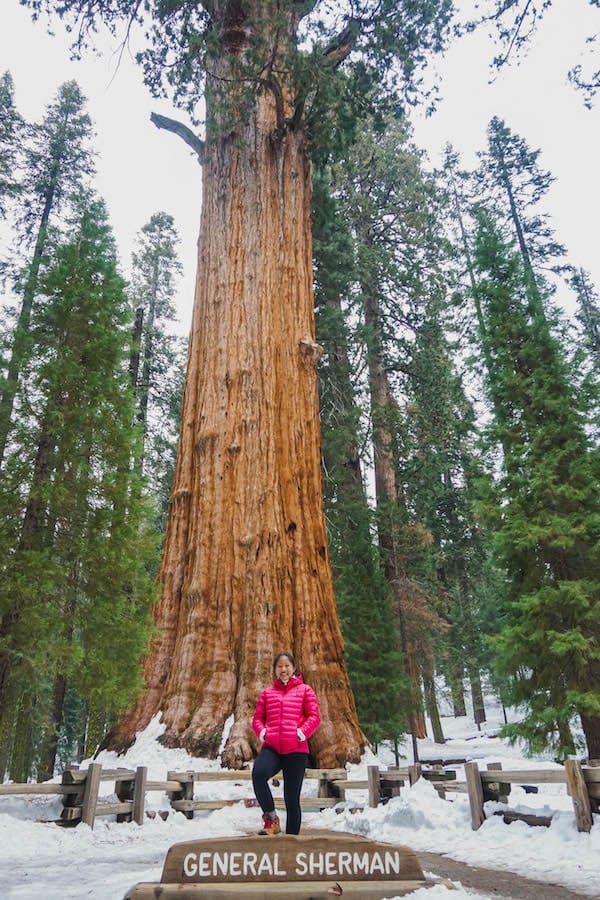
If there’s a winter shuttle running (usually during busy weekends), you can take a break from driving. Simply leave your car at the Giant Forest Museum parking area. This is at coordinates (36.565922, -118.773585) on Google Maps.
Our first stop is the General Sherman tree, which is just 1 shuttle stop away from the Giant Forest Museum. It runs every 15 minutes starting from around 10am. The shuttle hours vary each season, and perhaps based on the weather, so be sure to check before going.
Sequoias can live for thousands of years, which is how some of these trees are so large. The General Sherman tree is the largest tree based on trunk volume, and seeing it in person really puts it into perspective.
However, it tends to get crowded and busy here, so let’s snap some quick photos and move on to the fun part. There could be some snow on this trail, but it might be compact due to lots of people coming here, so you might not need snowshoes yet.
Hiking trail overview
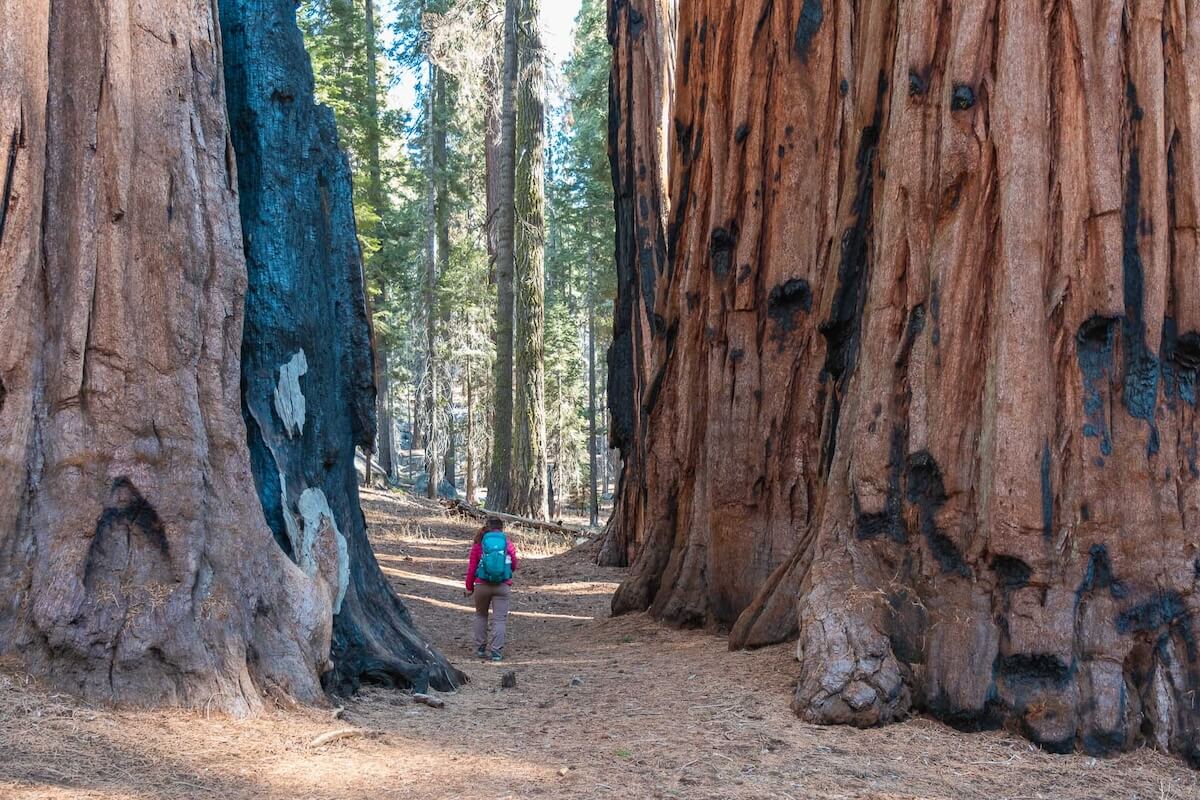
We’ll be doing part of the Congress Trail, continuing on to Alta Trail, and then finishing back near Big Trees Trail where we’ll explore the meadow there too.
- Total distance: 4.0 miles (6.4 km)
- Difficulty: Easy
- Elevation change: 370 ft (113 m), mostly downhill
- Link to AllTrails map
Unlock offline trail maps with AllTrails+ (crucial when trails are snow-covered)

See Sequoia groves along Congress Trail
After making a quick loop around the General Sherman Trail, continue on to Congress Trail. The trail does get a little slick and icy here, plus it’s downhill – so make sure to have microspikes with you in case you need it. If there’s lots of snow here, this is the best time to use your snowshoes.
McKinley and President Trees

As we continued walking along Congress Trail, the crowd thinned and we felt at ease to take funny pictures and videos with the trees. Many trees had burn scars at the base of their trunks, which you could walk through or hide inside.
There were also a few wooden benches where you can look up to admire the trees from below. Honestly, photos really don’t do these trees justice so you just need to soak it in when you’re there.
Even though trees don’t feel as epic to me as mountains, it’s amazing how they’re living things that have survived fires. In fact, their seeds get “activated” after a fire when the forest floor is cleared of competing plants.
The Senate and House Groves

The only thing better than a Sequoia tree is a whole grove of them. Part of the reason why we wanted to hike along Congress Trail was so that we could see these massive trees next to each other. Walking between the trees at the Senate and House Groves really helps you see how small you are compared to them.
Our exact winter day hike gear
This is the setup that lets us hike comfortably even with snow and ice on the trails:
Microspikes
Headlamp
Portable charger
Emergency bivvy

Scenic walk and lunch on Alta Trail
Alta Trail leads further south on our day’s journey, and it offers peace and quiet. I can only imagine how magical it is when the trails are covered in snow.
If the trails aren’t obvious because of the snow, follow your offline maps closely and also look out for yellow triangle pinecone signs on the trees for the Alta Trail.

For a quick lunch, I recommend bringing a freeze-dried backpacking meal because all you have to do is add boiling water. You’ll also need a backpacking stove and pot, and make sure to bring extra water too.
As we made our way towards the end of Alta Trail, we came across a fallen tree. We took pictures with the tree to remind us how big its base was.

Enjoy the snow near Big Trees Trail
It was just the middle of the afternoon which meant we still had time, so we crossed the Generals Highway road to get to the Big Trees Trail. This is a short loop that everyone can do, with educational boards telling you the story behind some of the trees, as well as the meadow ecosystem.
We saw plenty of snow in the meadow, with kids playing and dogs running around. However, we also saw lots of people slipping and sliding near the trailhead. Depending on when you go, it could either be snowy or icy.
Avoid running shoes here as they offer almost no traction on icy paths. Use microspikes as they turn regular hiking shoes into winter-safe footwear.
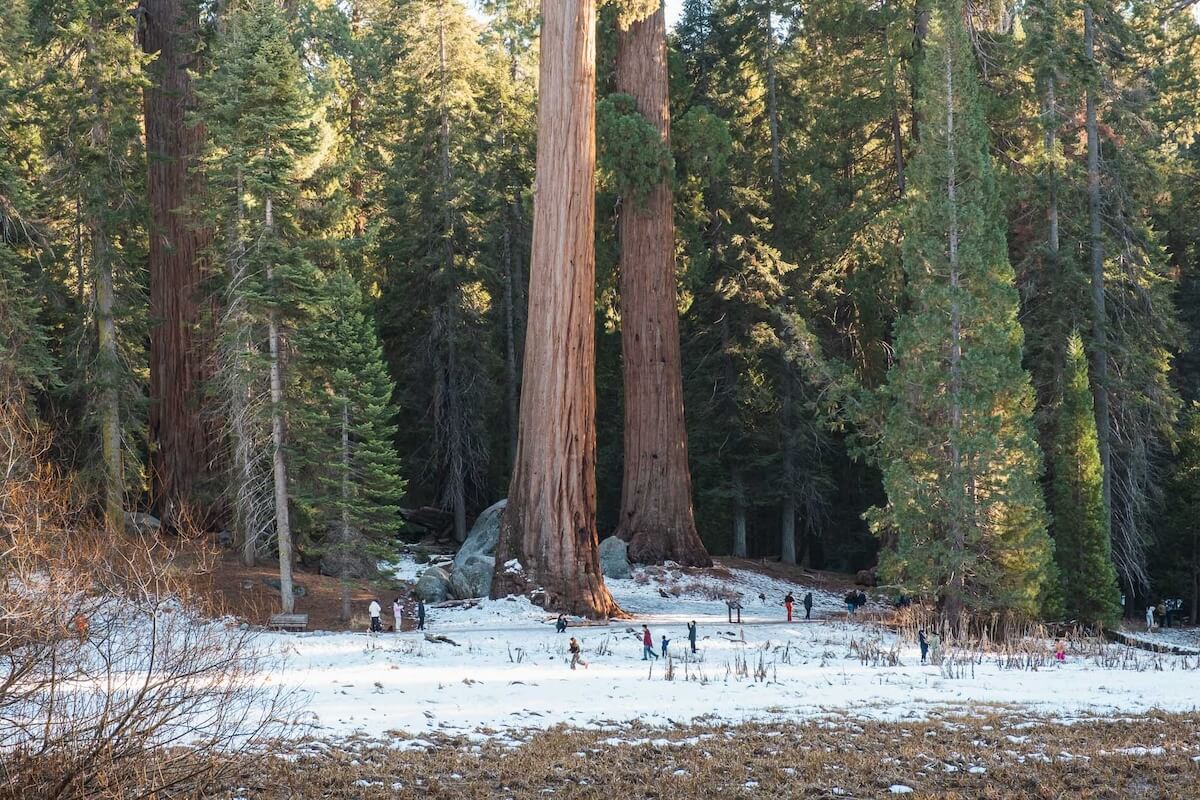
I would not recommend wearing running shoes here as they offer very little traction on icy paths. If you’re afraid of falling, microspikes are your best friend.
Aside from the winter trail conditions, it’s really beautiful here. There’s also a public bathroom at the trailhead.

Other ways to spend a day in Sequoia
Hike to Tunnel Log: If you have more time, you can hike out to Sequoia National Park’s Tunnel Log that’s about a 2-mile round trip detour from the Alta Trail. This is the fallen log that has a cut out allowing cars to pass through Crescent Meadow Road which usually gets closed when there’s too much snow.
Extend the hiking route: Take a detour to the Circular Meadow Loop and Crescent Meadow trails. This way, you’ll get to see Cattle Cabin, Chimney Tree, Tharp’s Log, Squatter’s Cabin, and Tunnel Log. It adds about 3 miles to your overall hike, based on this custom AllTrails map.

Visit the Giant Forest Museum: While waiting for the shuttle at Sequoia, why not see the displays in Giant Forest Museum. You’ll also see the Sentinel Tree nearby.
Dinner at The Gateway Restaurant and Lodge
To round off your trip to Sequoia National Park, head back down the winding roads to Three Rivers for dinner at The Gateway Restaurant and Lodge. We had our New Year’s Eve dinner there and enjoyed the old-school charm as we sat overlooking the river.

Things to bring to Sequoia in winter
If you’re visiting Sequoia in winter, this is what actually matters:
- Short daylight: Headlamp (even for “easy” trails)
- Deep snow forecast: Snowshoes (buy if you’d hike at least twice in snow)
- Icy packed trails: Microspikes (non-negotiable)

Snowshoes
You’ll be able to tell if you need snowshoes on your hike in Sequoia based on how much snow there is near the parking lot and the Big Trees Trail area.
We have the MSR Evo Trail snowshoes – a relatively affordable and great beginner option that is easy to take on and off. Another one we rented in the past was the MSR Evo Ascent snowshoes, which had a heel lift, making it suitable for steeper trails. This would be an upgrade we’d potentially consider next time.
Not only do snowshoes help you stay “afloat” on top of deep snow, you’ll also be less exhausted and have more fun on the trail. One time I hiked in late winter on a snowy trail, and was frustrated whenever I fell into icy cold puddles of melted snow.
It’s a great investment to have for years to come, so you don’t have to rent every year. Besides, having our own snowshoes would reduce the time we spend picking up and dropping them off, or having to care about store hours.
Best of all, we get to go on more winter adventures without worrying about rental costs.
Shop MSR Evo Trail Snowshoes here
Microspikes

The gold standard seems to be the Kahtoola MICROspikes, and so far it’s been quite comfortable and offers great traction on ice.
These are metal chain attachments you can attach your boots, with strong rubber grips that keep them on your feet. It really helps to stop you from falling when it’s slick and icy, so that you can venture out without worrying.
We bring microspikes in our backpack whenever we travel in the mountains because it allows us to take on winter hikes confidently. If there’s one thing I recommend you not to scrimp on, it’ll be microspikes because it could really save your life.
These are the microspikes we wear on icy Sequoia trails
Other winter hiking essentials
- Headlamp
- Backpacking stove, pot, and fuel
- Emergency shelter
- Gloves
- Portable charger for phone
Make sure to check out my winter hiking gear guide for additional safety tips and how to layer for warmth.
Concluding this 1-day Sequoia winter itinerary
Winter is probably the best time to visit Sequoia if you only have a day, especially when there’s lots of snow.
There’s nothing like getting up close and personal with these giant Sequoias through various hiking trails. You can either follow the easy route we took, or extend it to include more notable trees and meadow loops.
If you have more than one day, consider checking out Kings Canyon just north of Sequoia. You’ll find even more Sequoia groves there, including the famous General Grant Grove. Depending on snow and road conditions, you could even drive through Generals Highway from Sequoia to Kings Canyon.


